Futures market playbook
Futures Opening Range Breakout Strategy: NQ, ES, Volume, and Session Structure
Opening range breakout strategies use the early part of a trading session to define a high and low, then evaluate expansion beyond that range. The concept is especially popular in liquid index futures such as Nasdaq-100 E-mini or Micro contracts and S&P 500 E-mini or Micro contracts because the US cash open concentrates information, liquidity, and order flow. The setup is simple to describe but highly sensitive to range length, overnight context, economic releases, execution costs, and how the trader distinguishes a true expansion from the first stop run of the session.
Quick answer
Quick answer to futures opening range breakout strategy
A futures opening-range breakout defines a fixed opening window and trades or reviews expansion beyond its high or low. For NQ and ES, the rule should distinguish the U.S. cash-session opening range from the broader nearly 24-hour Globex session so the tested setup is unambiguous.
Key takeaways
- Use one consistent opening-range duration and session definition.
- Separate regular U.S. cash-session behavior from overnight Globex context.
- Opening-range breaks need confirmation and invalidation because the first move can reverse quickly.
What the opening range represents
The opening range is a predefined window after the start of the regular trading session. Common choices include the first 5, 15, or 30 minutes, but the exact duration is a strategy parameter rather than a universal truth. The high and low printed during that window become reference levels. Once the window closes, the trader evaluates whether price can leave the range with enough participation and room to continue.
The logic is that the cash open incorporates overnight information, institutional positioning, scheduled economic releases, and fresh liquidity. Early price discovery can establish a temporary balance area before one side gains control. On some days the range becomes the launch point for a trend. On others it becomes a trap that is broken repeatedly. A useful strategy therefore defines the range mechanically but treats the breakout as a separate decision requiring context.
Separate regular trading hours from overnight Globex structure
Index futures trade for much of the day and night, so the regular trading-hours opening range does not exist in isolation. Before the US cash open, mark the overnight high and low, prior-day high and low, prior settlement, and major higher-timeframe zones. A bullish opening-range breakout directly into the overnight high is different from a breakout that also clears the overnight structure and enters open space.
The overnight session can also establish a directional move before cash trading begins. If NQ or ES arrives at the open already extended far from the prior day's value, the first breakout may be more vulnerable to mean reversion. Conversely, a compressed overnight session can create more room for opening expansion. These are hypotheses that need testing, but recording overnight context prevents the first 15 minutes from becoming the only data in the decision.
Use centralized futures volume as participation context
A major advantage of exchange-traded futures is that the contract has centralized exchange volume for the relevant venue. That makes participation analysis more direct than in decentralized spot forex. Traders can compare opening volume with the same contract's recent opening periods, use relative volume, or monitor whether activity expands as price leaves the range. High volume does not guarantee continuation, but low participation can be useful context when a breakout barely clears the boundary.
Contract rollover matters. Volume migrates from the expiring contract into the next active contract, and historical continuous symbols may be back-adjusted or stitched differently by the data provider. For precise strategy testing, document which contract or continuous-symbol methodology is used. A rule based on volume should be tested on data that preserves the characteristics needed by the strategy rather than assuming every TradingView futures symbol is equivalent.
Confirm the opening-range break without chasing
The first push above or below the opening range can be a genuine trend initiation or a liquidity sweep. Confirmation methods include requiring a close beyond the boundary, measuring breakout distance relative to ATR, checking relative volume, waiting for a retest, or requiring alignment with the broader trend. Each method reduces some false signals but may enter later. A rule that waits for too much evidence can turn a good breakout into an extended chase with poor reward-to-risk.
A practical compromise is to separate alert and entry conditions. The range break triggers attention. The actual entry requires the additional criteria defined by the strategy. This is useful for discretionary traders because the chart can signal that something important happened without forcing immediate execution. The same structure works with TradingView alerts: one alert identifies the break, while the trader reviews volume, nearby levels, and invalidation before deciding whether the setup qualifies.
- Opening range fully defined before breakout signals are allowed
- Overnight and prior-day levels marked in advance
- Volume compared with a relevant intraday baseline
- Breakout close or retest rule defined before the session
- Maximum chase distance and invalidation rule fixed in advance
NQ and ES should not be treated as identical markets
Nasdaq-100 futures often exhibit larger percentage swings and faster intraday movement than S&P 500 futures. The same opening-range width, stop distance, or confirmation threshold may therefore behave very differently across NQ and ES. Micro contracts change contract size, not the underlying price behavior, but transaction costs and slippage can still matter more for smaller accounts and very short-term strategies.
Test each market independently. Record opening-range size in points and as a percentage or ATR fraction, volume characteristics, average breakout speed, and typical distance to invalidation. If one rule set is applied to both markets, verify that the normalization method actually makes them comparable. Avoid assuming that a strategy is robust merely because it produced trades on two related equity-index futures contracts.
Macro events and the US cash open
The US session frequently includes scheduled economic data before or after the cash open. CPI, payrolls, retail sales, ISM releases, Federal Reserve decisions, and major speeches can change volatility dramatically. On event days, the opening range may be much wider than normal or the real directional move may begin before the cash open. A strategy should define whether these days are included, excluded, or analyzed as a separate category.
Earnings from large index constituents can also affect NQ and ES differently. A major technology company reporting before the open may create concentrated Nasdaq movement even when the broader market is quieter. The opening-range concept still applies, but the source of volatility matters because spreads, gap size, and follow-through can differ from ordinary sessions. Record event context so the journal can distinguish routine days from information shocks.
Using B:PRO for an opening range breakout review
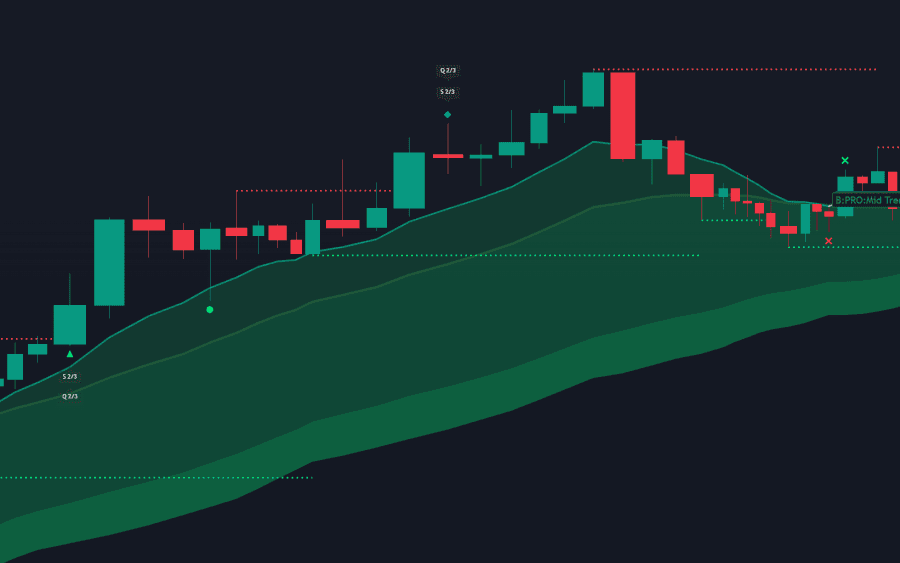
B:PRO can provide trend regime, structure, configurable filters, ratings, alerts, and target context on TradingView futures charts. For an opening range strategy, the range itself should remain an explicit session rule. Once price challenges the boundary, B:PRO can help the trader evaluate broader trend alignment and whether the chart environment supports continuation. This keeps the ORB logic transparent while using the indicator as a secondary decision framework.
Document the exact futures symbol, contract, timeframe, session settings, and data feed. If you use a continuous contract for context but execute the front-month contract, note the difference. Keep risk tied to the strategy's invalidation rather than to the indicator rating. A high-quality visual setup can still fail during the most liquid part of the day, and opening volatility can make losses grow quickly if position size is not planned before the break.
A robust ORB testing checklist
Test one opening-range duration at a time and include enough sessions to capture trend days, rotational days, event days, gap days, and low-volatility periods. Include commissions and a reasonable slippage assumption. Separate long and short trades and compare results across different overnight contexts. If a parameter is changed, begin a new test rather than combining the new rules with the old sample.
Useful review metrics include the percentage of sessions that break one or both sides of the range, time from range completion to first break, maximum favorable and adverse excursion, distance to prior-day and overnight levels, relative opening volume, and whether a retest occurred. These metrics explain how the strategy behaves. A single headline win rate does not show whether the process is robust or whether a small group of outlier trend days generated most of the result.
Futures are leveraged instruments and can move quickly around the cash open and major releases. This material is educational and does not provide individualized financial advice.
Frequently asked questions
What is the best opening range for futures?
Common windows include 5, 15, and 30 minutes, but no duration is universally best. Shorter ranges react sooner and can be noisier; longer ranges contain more price discovery but may enter later. Test one definition at a time.
Does opening range breakout work on NQ and ES?
Both markets are commonly used for ORB research, but their volatility and intraday behavior differ. A strategy should be tested separately on NQ and ES rather than assuming the same thresholds will transfer directly.
Should overnight highs and lows be included in an ORB strategy?
They are useful context because the regular-session opening range forms inside a market that has already traded overnight. Whether they are a formal filter should be defined and tested rather than assumed.
Can B:PRO be used with a futures opening range breakout?
Yes, as a TradingView trend, structure, filter, alert, and target framework. The opening-range window and execution rules should remain explicitly defined so the session strategy stays testable.
Sources & further reading
Primary references
References support platform mechanics, market structure definitions, or product documentation. They do not imply performance guarantees or endorsements.
Continue your research