Crypto market playbook
Crypto Breakout Trading Strategy: Structure, Volume, Volatility, and 24/7 Market Context
Crypto is well suited to breakout trading because it trades continuously, regularly transitions between compression and expansion, and often reacts strongly when widely watched levels fail. The same features also create traps: liquidity changes across the day and weekend, exchange volume is fragmented, leverage can accelerate liquidations, and a breakout that looks clean on one venue may be less convincing on another. A robust crypto breakout process therefore starts with structure and data quality before it considers any signal.
Quick answer
Quick answer to crypto breakout trading strategy
Crypto breakout trading uses the same structure-first logic as other markets, but 24/7 trading, exchange-specific liquidity, weekend conditions, and fragmented volume make context especially important. A crypto breakout rule should specify the exchange or feed, timeframe, confirmation method, and invalidation before the trade.
Key takeaways
- Crypto trades continuously, so session and weekend liquidity can change breakout behavior.
- Volume can differ materially by exchange or aggregate data source.
- Use a fixed structure and confirmation process rather than retuning rules after each move.
Why crypto breakouts behave differently
Crypto trades 24 hours a day, seven days a week, so there is no single official open or close comparable with a stock exchange session. Activity still follows rhythms. Liquidity often changes around European and US trading hours, major macro releases, funding intervals, and weekends. A level formed during thin conditions may not carry the same weight as one built during a high-participation period. Traders should therefore record when the range formed, not only where its boundaries are.
The market is also fragmented across exchanges and instrument types. BTC spot on one venue, BTC perpetual futures on another, and a composite TradingView feed can show slightly different highs, lows, and volume. That matters when a strategy relies on a precise breakout level. Choose a consistent feed for testing, use the same feed for alerts and review, and avoid changing exchanges after a losing trade simply because another chart makes the setup look cleaner.
Build the setup around clear crypto structure
Useful crypto breakout structures include multi-hour ranges, prior daily or weekly highs and lows, repeated horizontal reaction zones, compression after a directional move, and local swing structures within a broader trend. The best level is not necessarily the one touched most often. It is the one that can be defined objectively before price crosses it and that creates a clear distinction between continuation and failure.
For intraday trading, mark the range while it is forming and note whether the higher-timeframe trend supports the expected direction. A breakout from a tight range inside a strong trend has different context from a breakout directly into a major weekly level. If the next opposing structure is too close, the potential reward may be limited even when the breakout itself is technically valid. Structure should therefore define both the trigger and the space available after the trigger.
Use volume and leverage data carefully
Volume can help confirm that participation increased as price left a range, but crypto volume depends on the exchange or data source. Compare current activity with a baseline from the same feed. Relative volume is usually more useful than an absolute threshold. If a breakout occurs with unusually low activity, the move may still continue, but it offers less evidence that broad participation supported the level break.
Open interest and funding can add context for perpetual futures, but they should not be treated as directional signals on their own. Rising open interest means new positions are being added, not that those positions are necessarily bullish. Positive funding can indicate long-side crowding, yet strong trends can remain positively funded for extended periods. Use leverage metrics to understand positioning pressure and liquidation risk, not to replace price structure and risk management.
Common crypto false-breakout patterns
One common failure is the liquidity sweep: price trades briefly beyond a visible high or low, triggers stops and breakout entries, then returns inside the prior range. Another is the low-liquidity weekend break, where price moves through a level without the participation normally seen during the week. A third is a news-driven spike that crosses structure before spreads and volatility normalize. Waiting for a close, requiring relative volume, or demanding room beyond the level can reduce some of these trades, but every filter introduces a cost in later entry or fewer opportunities.
The goal is not to eliminate false breakouts; that is impossible. The goal is to define what failure looks like and keep the loss manageable when it occurs. If the strategy requires a close outside the range, a close back inside can be a logical invalidation signal. If the setup is based on a retest, failure to hold the broken level may invalidate it. Use a rule tied to the original reason for the trade rather than an arbitrary loss amount chosen after price moves against you.
Choosing crypto timeframes and session context
Lower timeframes create more breakout signals but also more noise, exchange-specific wicks, and transaction-cost sensitivity. Higher timeframes provide cleaner structure but larger invalidation distances and fewer setups. Many traders combine the two: use a higher timeframe to define regime and major levels, then a lower timeframe to observe the actual break and retest. The exact combination should match how often you can monitor the market and how much price movement your risk plan can absorb.
Session context remains useful even though crypto never closes. Note whether the setup occurs during Asian, European, or US activity, around major economic releases, or during a weekend. If your historical test mixes all hours together, you may miss meaningful differences in spread, volume, and volatility. A simple time-of-day column in the trade journal can reveal whether a strategy is concentrated in specific liquidity windows without forcing you to trade only those hours.
Using B:PRO for crypto breakout review
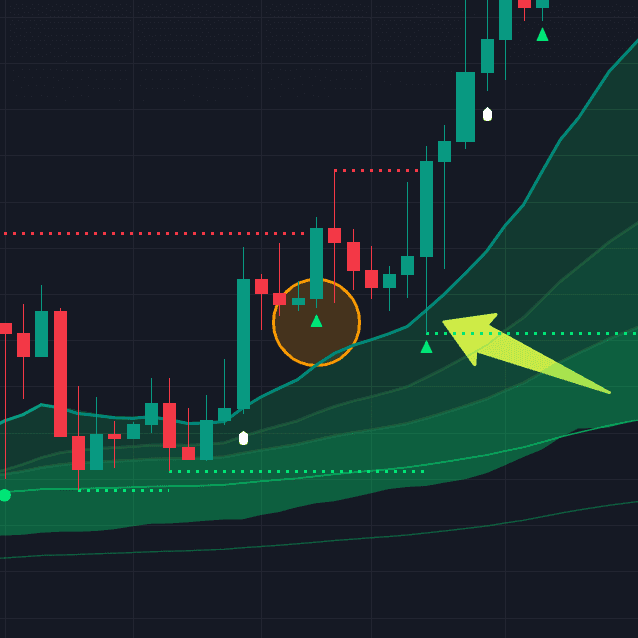
B:PRO is designed to be symbol-agnostic inside TradingView, so the same framework can be applied to crypto charts subject to the quality of the selected data feed. The Cloud and structure layers can provide regime and reaction context, while configurable filters, Safety and Quality ratings, alerts, and Future Targets can organize the review. The tool does not remove the need to understand exchange-specific volume, perpetual-futures positioning, or the difference between spot and derivatives markets.
Keep the product settings stable during testing and record the exact symbol, exchange, timeframe, and market type. BTCUSDT perpetual on one venue is not identical to BTCUSD spot on another. If you change the feed, treat it as a different test. Alerts are particularly useful in crypto because the market trades continuously, but they should bring you to the chart for review rather than encourage automatic action from a mobile notification.
Crypto breakout checklist
Before the breakout, define the range and higher-timeframe context. At the event, check whether the move satisfies your close rule, whether participation is normal or elevated, and whether the breakout is occurring during a known liquidity or news window. After the event, confirm that the next opposing structure leaves enough room for the trade plan. Finally, define invalidation and position size before entry. A clean process turns a fast-moving crypto chart into a sequence of questions instead of an emotional reaction.
Review outcomes in groups rather than one by one. Separate trending and ranging regimes, weekday and weekend signals, high- and low-volume breaks, and different exchanges if necessary. The objective is to discover where the strategy is understandable and repeatable. If a rule only works after constant parameter changes, the apparent edge may be a result of overfitting rather than a robust trading process.
- Predefined range or swing level
- Consistent exchange and instrument feed
- Higher-timeframe trend and nearby opposing structure
- Relative volume or participation context
- Defined candle-close or retest rule
- Invalidation, position size, and maximum account risk before entry
Frequently asked questions
What is the best timeframe for crypto breakout trading?
There is no universal best timeframe. Lower charts offer more signals and more noise; higher charts offer clearer structure but larger moves and fewer opportunities. Test a combination that matches your monitoring time and risk plan.
Should crypto breakouts be confirmed with volume?
Volume can add useful participation context, but it is exchange-dependent. Compare volume with a baseline from the same feed and avoid treating one threshold as universal across exchanges.
Are weekend crypto breakouts less reliable?
Weekend liquidity and participation can differ from weekdays, which may change breakout behavior. That does not make every weekend breakout invalid. Track weekend and weekday setups separately to see whether the difference matters for your strategy.
Can B:PRO be used on Bitcoin and Ethereum?
B:PRO is designed to work across TradingView symbols, including crypto, subject to the trader's own testing. Use a consistent exchange feed and forward-test the chosen timeframe and settings before relying on the workflow with live capital.
Sources & further reading
Primary references
References support platform mechanics, market structure definitions, or product documentation. They do not imply performance guarantees or endorsements.
Continue your research