Breakout confirmation framework
How to Confirm Breakouts with Volume, ATR, and Market Structure
A breakout should answer more than one question. Market structure defines the level. Volume asks whether participation expanded. ATR tells you whether the move is meaningful relative to recent volatility. Used together, these inputs can create a clearer review process without pretending that confirmation removes risk. The objective is to reject obviously weak conditions and make every accepted setup easier to explain before entry.
Quick answer
Quick answer to confirm breakouts volume ATR structure
A practical breakout-confirmation framework uses market structure to define the level, volume to assess participation, and ATR to judge whether the move is meaningful relative to recent volatility. These inputs complement each other because they answer different questions.
Key takeaways
- Mark structure before the breakout to reduce hindsight bias.
- Compare volume with a relevant baseline rather than relying on one absolute number.
- ATR measures volatility, not direction, and is useful for normalizing breakout distance and risk.
Step 1: define market structure before price breaks it
The most important part of breakout confirmation happens before the breakout. Mark the level that matters while price is still below resistance or above support. It can be a prior swing, a consolidation boundary, a session range, a multi-touch zone, or a higher-timeframe level. If the level only becomes obvious after price has already moved, the setup is vulnerable to hindsight bias. A valid review starts with a structure definition that existed in advance.
Structure also tells you what the breakout is escaping from. A move out of a multi-hour compression carries different information from a one-tick push above the previous candle. The cleaner the base, the easier it is to define failure. For bullish setups, a close back inside the prior range or below the broken level may be relevant invalidation. For bearish setups, the opposite applies. Exact rules should be chosen before entry and tested for the market and timeframe.
Step 2: use volume to measure participation
Volume is useful because a breakout is partly a participation event. When price moves through a widely watched level while activity increases, the move has more evidence behind it than an identical price change occurring during thin participation. That does not mean every high-volume breakout succeeds. Large volume can also appear during exhaustion or news-driven reversals. The value of volume is comparative: it helps you ask whether current activity is unusual relative to the recent baseline.
The correct volume measure depends on the market. Exchange-traded futures and many stocks have centralized or venue-specific volume. Crypto volume varies by exchange and aggregate feed. Spot forex usually has no centralized global volume, so TradingView feeds commonly show tick volume or broker-specific activity. Treat these sources differently. A rule such as volume above a 20-bar average should be tested separately for each market rather than copied blindly across asset classes.
- Compare current volume with a rolling baseline instead of using an arbitrary absolute number
- Look for expansion near the actual structure break, not several bars later
- Distinguish centralized exchange volume from broker or exchange-specific proxies
- Avoid treating one high-volume candle as automatic confirmation when structure is poor
Step 3: use ATR to normalize the breakout distance
Average True Range does not predict direction. It measures how much the market has recently been moving. That makes ATR useful for answering a different question: is the apparent breakout large enough to matter relative to normal noise? A five-point move can be significant in one regime and irrelevant in another. Expressing the distance beyond the level as a fraction of ATR gives the rule a volatility-aware scale that adapts as the market speeds up or slows down.
There is no universal ATR threshold. Some traders require a close a fraction of one ATR beyond the level; others use ATR only for invalidation, stop distance, or a filter that rejects unusually extended entries. The key is consistency. Choose the ATR length, timeframe, and threshold before testing. Avoid adjusting the threshold after each trade. If ATR becomes a flexible excuse rather than a fixed rule, it adds complexity without improving the process.
ATR is a volatility measure, not a directional signal. A large ATR reading does not make a bullish or bearish breakout more likely by itself.
Step 4: combine the candle close with trend context
Intrabar price can move above resistance and then close back inside the range. Requiring a confirmed close is one common way to reduce sensitivity to brief probes. The trade-off is later entry and potentially larger distance to invalidation. There is no universally correct choice. What matters is that your rule distinguishes an early alert from a confirmed event and that you know whether your indicator updates during the live candle or waits for bar confirmation.
Trend context adds another independent layer. A bullish structure break aligned with a higher-timeframe uptrend is different from a bullish break directly into higher-timeframe resistance. A cloud, moving-average regime, market structure trend, or higher-timeframe bias can all serve this purpose. Avoid counting several highly correlated trend indicators as separate votes. One clear regime measure is usually more interpretable than five indicators that all derive from similar price information.
A five-question breakout confirmation workflow
The most useful confirmation process is short enough to apply under pressure. First, define the level. Second, ask whether the close actually cleared it according to your rules. Third, compare volume with the recent baseline. Fourth, check whether the distance is meaningful relative to ATR. Fifth, identify invalidation and the next opposing structure. If one of these questions has no answer, the setup is incomplete even if the chart looks exciting.
This framework also makes alerts more useful. An alert can tell you that price challenged or closed beyond structure, but the trader still reviews volume, volatility, regime, and risk. That separation prevents a notification from becoming an automatic trade instruction. It is especially important on mobile, where the temptation is to act on a signal without opening the full chart and checking the context that produced it.
- Where is the pre-defined structure level?
- Did price confirm beyond it according to the candle-close rule?
- Is participation stronger or weaker than the recent baseline?
- Is the move meaningful relative to recent ATR?
- Where is invalidation and what opposing structure comes next?
How this framework can be used alongside B:PRO
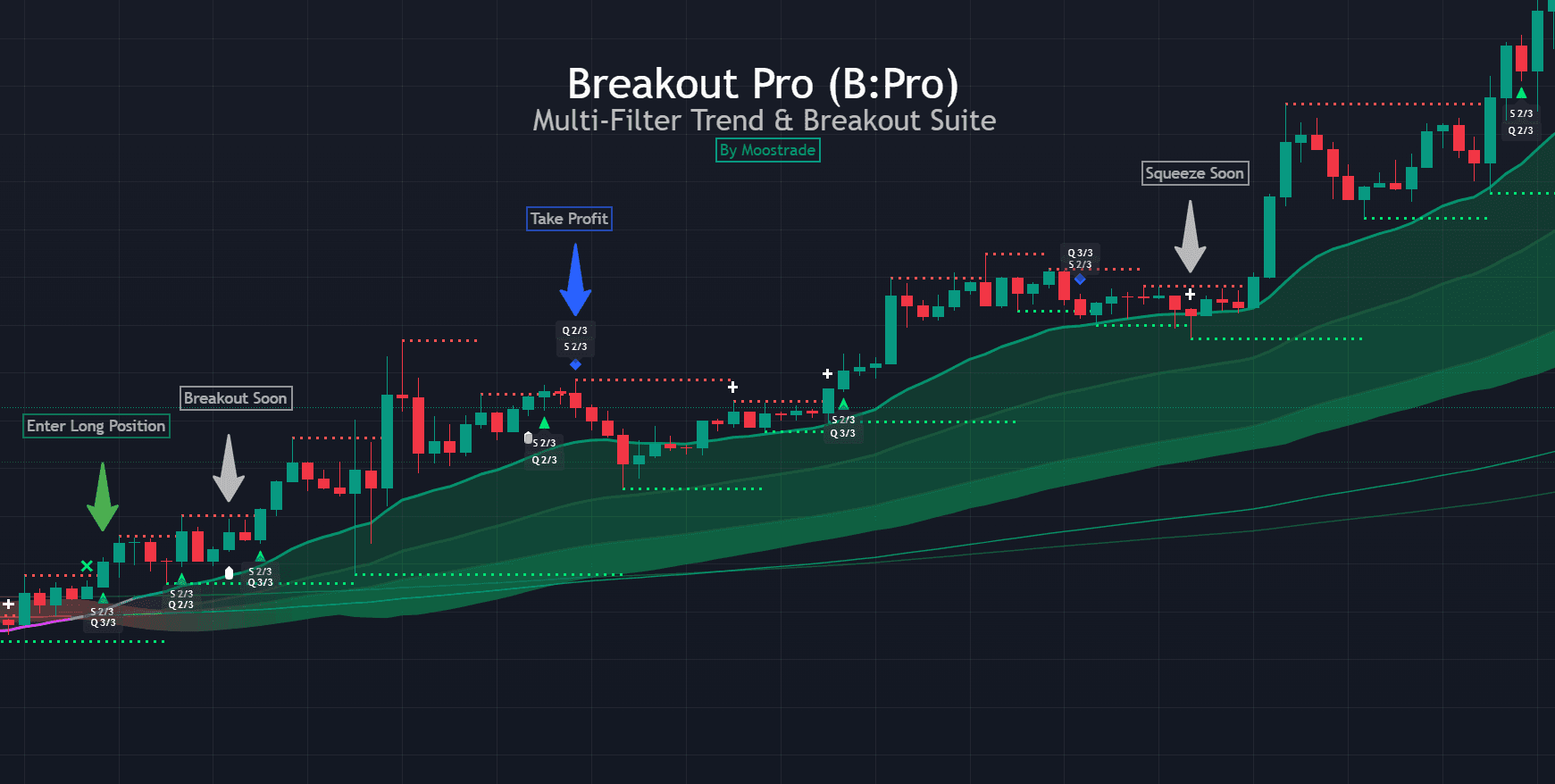
B:PRO already organizes structure, trend context, configurable confirmation filters, ratings, alerts, and target guidance in one TradingView workflow. Its documented filter set includes participation, momentum, volatility, and higher-timeframe inputs such as Volume, Bollinger/Keltner logic, VWAP, ADX, OBV, Ichimoku, and higher-timeframe levels. ATR is not required to use B:PRO, and traders who prefer ATR can add it as a separate volatility reference rather than assuming it is part of the B:PRO scoring model.
A sensible workflow is to let B:PRO define the broader regime and event context, then apply your own fixed ATR rule if volatility normalization is important to your plan. That keeps the product behavior and the trader's additional rule separate. Document both. If a setup is rejected because ATR distance is too small or too extended, record that reason explicitly instead of retroactively changing how the B:PRO signal itself is interpreted.
Common confirmation mistakes
The first mistake is adding confirmation after the outcome is visible. A trader sees a winning breakout and notices that volume was high, then sees a losing breakout and decides ATR was too low. That is not a testable system because the rules change with the result. The second mistake is double-counting similar information. RSI, MACD, Stoch RSI, and several moving averages can create the impression of four confirmations while largely responding to the same price movement.
The third mistake is ignoring market-specific data quality. Crypto exchange volume, forex tick volume, and futures exchange volume are not interchangeable. The fourth is allowing confirmation to make risk larger. A setup with strong context can still fail, so position size should come from predefined risk and invalidation, not from how convincing the signal appears. Confirmation can improve selectivity, but it should never be used to justify unlimited confidence.
Frequently asked questions
How much volume is needed to confirm a breakout?
There is no universal volume threshold. A relative rule, such as comparing current volume with a rolling average or percentile, is usually more portable than an absolute number. The rule should be tested separately for each market and timeframe.
What ATR setting is best for breakout confirmation?
ATR 14 is common, but there is no universally best setting. The useful setting is the one you define before testing and keep stable long enough to evaluate across different volatility regimes.
Should I wait for the candle to close above resistance?
A close-confirmation rule can reduce brief intrabar probes but creates later entries. Some strategies intentionally enter earlier. Choose one approach, document it, and test the trade-off instead of switching based on the latest outcome.
Does B:PRO use ATR?
B:PRO's documented framework includes structure, trend, volume, momentum, volatility, higher-timeframe filters, ratings, alerts, and targets. ATR can be added separately by traders who want an explicit ATR-based volatility rule; it should not be assumed to be part of B:PRO unless stated in the current product documentation.
Sources & further reading
Primary references
References support platform mechanics, market structure definitions, or product documentation. They do not imply performance guarantees or endorsements.
Continue your research